Kontrapovijest
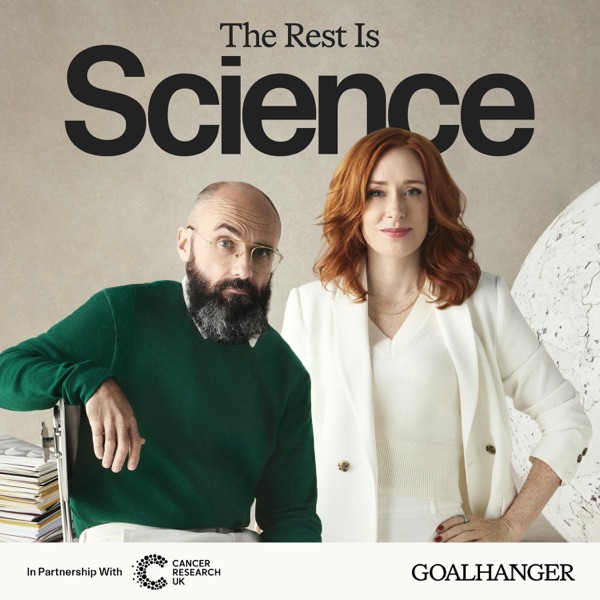
Some of the creepiest sounds ever recorded aren't from horror films. They're real. From mysterious noises from the deepest parts of the ocean to the eerie voices of people who died more than a century ago, the world is full of sounds stranger than anything we could dream up. But what on Earth is making them? In this Halloween special of The Rest Is Science, Professor Hannah Fry and Michael Stevens (Vsauce) listen to some of the world's most mysterious and unsettling recordings, attempting to identify their origins and uncover the surprising science behind them. They travel back to 1860 to hear a voice that was never intended to be heard again, investigate a bizarre underwater noise that baffled scientists for a decade, and encounter a sound so strange that Hannah suspects it might have come from outer space. Turn up the volume, put on your headphones, and see how many you can identify…before Hannah does. ------------------- For more information about Cancer Research UK, their research, breakthroughs and how…
Some of the creepiest sounds ever recorded aren't from horror films. They're real. From mysterious noises from the deepest parts of the ocean to the eerie voices of people who died more than a century ago, the world is full of sounds stranger than anything we could dream up. But what on Earth is making them? In this Halloween special of The Rest Is Science, Professor Hannah Fry and Michael Stevens (Vsauce) listen to some of the world's most mysterious and unsettling recordings, attempting to identify their origins and uncover the surprising science behind them. They travel back to 1860 to hear a voice that was never intended to be heard again, investigate a bizarre underwater noise that baffled scientists for a decade, and encounter a sound so strange that Hannah suspects it might have come from outer space. Turn up the volume, put on your headphones, and see how many you can identify…before Hannah does. ------------------- For more information about Cancer Research UK, their research, breakthroughs and how…
Some of the creepiest sounds ever recorded aren't from horror films. They're real. From mysterious noises from the deepest parts of the ocean to the eerie voices of people who died more than a century ago, the world is full of sounds stranger than anything we could dream up. But what on Earth is making them? In this Halloween special of The Rest Is Science, Professor Hannah Fry and Michael Stevens (Vsauce) listen to some of the world's most mysterious and unsettling recordings, attempting to identify their origins and uncover the surprising science behind them. They travel back to 1860 to hear a voice that was never intended to be heard again, investigate a bizarre underwater noise that baffled scientists for a decade, and encounter a sound so strange that Hannah suspects it might have come from outer space. Turn up the volume, put on your headphones, and see how many you can identify…before Hannah does. ------------------- For more information about Cancer Research UK, their research, breakthroughs and how…
A sundial can be almost 16 minutes fast in November and 14 minutes slow in February, yet there's nothing wrong with it. So why does the Sun, our oldest timekeeper, disagree with the clock on your wrist? In this episode, Professor Hannah Fry and Michael Stevens (Vsauce) explore the equation of time - the strange relationship between Earth's tilt, its orbit around the Sun and the way we measure our days. Why does a day last 24 hours? Has it always been that way? And how can a piece of ancient coral reveal that time itself has changed? To find out, Hannah and Michael investigate an ingenious sundial that appears to correct its own mistakes, and discover the extraordinary places on Earth where shadows disappear completely. Along the way, they explore why sailors relied on the stars, the Moon's remarkable journey across London's sky, and the curious fact that the Pacific Ocean is so enormous it meets itself on the other side of the world. Michael's references:https://rl.se/subsolarpoint…
In many parts of the world, people rest in a deep squat every day. In others, most adults can barely get down there. So what’s going on? Hannah Fry and Michael Stevens dig into the history of squatting and why the ability to squat differs so much between cultures.Plus, your questions: What happens to the air pressure inside a car when it goes round a bend? Why do some burps come out higher than others? And why do tautologies sound like wisdom?-------------------For more information about Cancer Research UK, their research, breakthroughs and how you can support them, visit https://cancerresearchuk.org/restisscience Cancer Research UK is a registered charity in England and Wales (1089464), Scotland (SC041666), the Isle of Man (1103) and Jersey (247). A company limited by guarantee. Registered company in England and Wales (4325234) and the Isle of Man (5713F). Registered address: 2 Redman Place, London, E20 1JQ. ------------------- Find The Rest Is Science all over the internet by clicking here.…
OpenAI claims a swarm of AI agents has solved the Navier-Stokes problem, one of the hardest unsolved questions in mathematics, with a $1 million prize attached. Then it released more than 700 more mathematical manuscripts, including claims touching the Riemann hypothesis, faster than anyone can check them. Mathematicians are not happy, and the reason goes far beyond the money. In this episode of The Rest of Science, mathematician and fluid dynamicist Hannah Fry takes Michael Stevens through the equations that describe everything that flows, from the blood in your veins to a rocket leaving the atmosphere. Then she tells him why this story has turned the vocation of mathematics upside down. Ten thousand AI agents. Millions of messages. One tiny term in the equation that nobody wanted to look at, until it unlocked the problem. But did AI really solve a million dollar problem? Why are some mathematicians accusing the models of stealing their work? And how might a proof that is completely correct be the least…
A can of fizzy drink has been violently shaken. The pressure is building, the bubbles are ready to erupt, and Michael Stevens is about to open it. But Hannah Fry has a trick up her sleeve. Can a few taps really prevent an explosion?This week on The Rest Is Science, Hannah and Michael begin with the surprisingly complicated physics of carbonation before tackling a much bigger question: can we really trust science?From the replication crisis and scientific studies that fail to stand up to scrutiny, to the strange incentives that shape what gets published, they explore why even respected scientific discoveries can turn out to be wrong...and why that might not be such a bad thing.Along the way, they investigate whether Archimedes really could have moved the Earth with a long enough lever, why aircraft are designed to withstand enormous pressure changes, and what happens when we lose our curiosity.Plus, an unexpected discussion about nuns, the dangers of absolute certainty, and why asking questions might be one…